PATTI CUDD PERCUSSIONIST
  • Home
  • Bio
  • Concerts
  • Cyanotypes
  • still motion
  • Eos
  • Discography
  • News and Pictures
  • Collaborators
    • Images
  • Repertoire
  • YouTube
    • SoundCloud
    • Facebook
  • Contact
  • Bandcamp
Picture
Picture
My new CD has arrived!  Please check it out!

A nice review from JW Vibes!   
​​Another review from Jazz Weekly!


Here is what Neuma has to say about the recording!
​

Percussionist with a vision, Patti Cudd, announces the release of Cyanotypes, a landmark portrait of five forward looking works for percussion and electronics; all – in a field dominated by men – composed by women. This meticulously crafted collection is a testament to creative risk-taking, subtle technology, collaborative spirit, and the resonant possibilities of struck sound.

Cyanotypes is not just a photo album; it’s an auditory, sensory expedition. Each piece serves as a unique blueprint—a sonic cyanotype—that reimagines the role of percussion. From the rhythmic imprints of a snare drum mapped onto a vibraphone to the cheeky ambitions of a humble wine bottle, the album invites listeners into a world where everyday objects become instruments of profound expression and complex algorithms dance with human gesture.

“The works on this album challenged me to think like an architect of sound, building structures from rhythm, texture, and electronic transformation,” says Cudd. “Each composer presented a unique world to explore, and it was a joy to collaborate with them to bring these vibrant, playful, and deeply expressive blueprints to life.”

The album features five world-premiere recordings from composers based in Ireland, Brazil, and across the US:
1. Cyanotypes by Elainie Lillios: A five-movement study inspired by a natural photographic process, rendering the snare drum’s articulations onto the resonant canvas of the vibraphone.
2. This bottle has notions by Kerry Hagan: A playful and whimsical piece where a simple bottle’s sound is transformed by electronics, yielding its surprising and ambitious ego.
3. Chime by Tiffany Skidmore: An intricate work where rotating pitch constellations and a liquidating rhythmic structure unfold across two snare drums and six crotales.
4. The Meeting Place by Heather Dea Jennings: A cross-cultural dialogue layering Brazilian drum traditions with live electronics, inspired by Yoruba proverbs and composed in memory of Alvin Lucier.
5. Tattoo of a Gesture by Margaret Schedel (with Christopher Howard): A nine-movement collaboration foregrounding the body’s agency, where a single bendir drum and a carry-on case of implements converge with interactive processing in a tattered acousmatic veil.
       
​

A nice review of Cyanotypes by Fanfare Magazine! 


CD Review by Huntley DentCYANOTYPES • Patti Cudd (perc) • NEUMA 240 (71:57)

ELAINIE LILLIOS Cyanotypes. KERRY HAGAN This bottle has notions. TIFFANY SKIDMORE Chime. HEATHER DEA JENNINGS The Meeting Place. MARGARET SCHEDEL Tattoo of a Gesture
In the opening sentence of the booklet note, Patti Cudd is described as a percussionist with a vision, which I can easily and happily agree with. Of all the traditional instrumental groups, the percussion have benefited the most from New Music exploration. In this recital Cudd, who has premiered over 200 new works, brings to light three main threads that make contemporary percussion works sound contemporary. First is the blurring of traditional lines about what constitutes a percussion instrument, then the use of everyday sounds as musical objects, and finally the infusion of electronics. The choices have moved far beyond drums, cymbals, and mallet instruments.

Cudd is comfortable across the entire terrain, and general listeners shouldn’t imagine any pink flags, fearing that contemporary percussion by definition will be louder, wilder, and more aggressive. Those qualities can be present, undoubtedly, but not here. One enticing reason for non-percussion specialists to listen is the surprise of moods that are gentle, lyrical, and atmospheric. The five women composers who were commissioned to create these new works have done their best to ignore the stereotypes of traditional percussion in the service of an unexpected soundscape.
The title track, Cyanotypes, grew from a perplexing request. Cudd asked composer Elainie Lillios to write a piece that treated the vibraphone like a snare drum. The concept is almost Zen-like, and Lillios was stumped until she hit upon the photographic technique known as a cyanotype, in which the photographed object is rendered in white against a blue background (its best-known use is for architectural blue­prints). This gave Lillios the inspiration to use an imprint of the snare drum’s “rhythmic and articulate characteristics,” from which her five-movement piece gained its shades of blue (Prussian, Midnight, Sapphire, Cobalt, and Cetacean).

Although technically intriguing and useful as an overall concept for the album, which can be viewed as studies in percussion architecture, the takeaway in the first movement of Cyanotypes is that the vibraphone is struck in sharp, quick drum-like strokes, while the expected sustained vibrancy associated with the instrument is employed in the second movement. There is a light layer of electronica, which isn’t always distinguishable from untreated tapping and scraping sounds. This blurring is creative and refreshingly imaginative. The layering, which also seems to include murmured vocalizations, draws in the ear.

This invitation to listen is a signature of this album. New Music often takes the stance that the listener is expected to do all the work of sustaining interest and deciphering musical value. In the second piece, This bottle has notions by Kerry Hagan, a wine bottle becomes the protagonist in an implied Walter Mitty fantasy. As the booklet note describes this playful transformation from modesty to aspiration, “A simple bottle’s sound is transformed by electronics, yielding its surprising and ambitious ego.” The overall effect is whimsical, underlined by a voice muttering “Bottle, bottle, bottle” and fragments of a popular song from 1925, “Show Me the Way to Go Home,” a plea from someone not quite sober. Near the end the instrumentation expands beyond a wine bottle to include a full drum set and starts to rock.

The simple title of Tiffany Skidmore’s Chime conceals some complex underpinning, in which “rotating pitch constellations and a liquidating rhythmic structure unfold.” The surface of the soundscape is restricted to two snare drums and six crotales, the tinkling of the one offsetting the increasing intricacy of the other. The work is entirely acoustic and evokes the mesmerizing image of cicadas in the tree tops as wind chimes on the porch are stirred by a light evening breeze.
The American-born composer Heather Dea Jennings is based in Brazil and uses that country’s legacy as the foundation of The Meeting Place. It seems esoteric to read that the score “layers Brazilian alfaia drum traditions with live electronics, drawing inspiration from Yoruba proverbs in Yoruba, English, and Portuguese.” But Jennings has tapped into a fairly familiar use of language-as-sound in New Music. A tapestry of words, some intentionally unintelligible, is electronically merged into music, where diverse cultural strands find their meeting place, as the title says. Whole sentences are often present, however, and the focus is on the rhythmic quality of speech rather than melody. Cudd provides drummed accompaniment to a piece where voices and electronica are dominant in an intriguing, at times mysterious, way. I’ll confess that hearing repeatedly about the passing on of old loincloths didn’t add to my appreciation.

Finally, Tattoo of a Gesture, by Margaret Schedel, plunges us into the sort of New Music jargon that puts off general listeners, as witness this description: “A nine-movement collaboration foregrounding the body’s agency, where a single bendir drum and a carry-on case of implements converge with interactive processing in a tattered acousmatic veil.” The carry-on contains the found-object percussion that has become fashionable: “a wide variety of strikers, a small bongo, a metallic choir of bells, bowls, cymbals, and cups; and three wooden slats treated with moleskin, sandpaper, and drilled holes.”
You now know enough without listening to this dry, abstract piece, which randomly shuffles everyday sounds with the interjected beat of the bendir, a wooden-framed native drum from North Africa often associated with Sufis. The texture of Tattoo of a Gesture sounds to me like the background of a work awaiting some substance. As it stands, the score contains many miscellaneous innocuous sounds.
My reservations concern only one work, which other listeners might hear in a different way. What comes across overall is the ingenuity and unexpected flexibility of contemporary percussion music. Cudd, who obtained her doctorate at the University of California, San Diego and studied in Copenhagen on a Fulbright fellowship, is a master of her craft, as evidenced by the subtlety of all five performances. If you have a stereotype of percussion recitals, here is a welcome chance to open new horizons. Huntley Dent

This article originally appeared in Issue 49:5 (May/June 2026) of Fanfare Magazine.

About me:

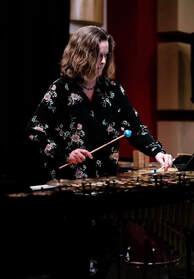
Minnesota-based Patti Cudd is a versatile percussionist known for her dynamic performances that blur the lines between traditional percussion, electronics, and experimental sound. Equally at home in concert halls, festivals, and innovative multimedia projects, she brings a playful curiosity and deep musicality to every stage. Her collaborations span composers, ensembles (including Zeitgeist), and interdisciplinary artists, exploring rhythm, gesture, and sonic transformation. Patti’s artistry transforms everyday objects into instruments of expression, revealing unexpected textures and colors. A dedicated educator and mentor, she inspires emerging musicians while continuing to push the boundaries of contemporary percussion.

​Percussionist Patti Cudd is an active performer of the music of the 21st century.   As a champion of modern music, she has given concerts and master classes throughout the United States, Korea, Thailand, China, Mexico, South America and Europe. 

​She has participated in such festivals as the Bang on a Can Festival at Lincoln Center, ICMC  (Athens, Greece),  Frau Musica Nova (Cologne, Germany), Mexico City’s Ciclo de Percusiones Series, Interactive Arts Performance Seriesin NYC, NYCEMF, PASIC,  SARC (Belfast, Ireland), GRIM (Marseille, France),The North American New Music Festival (Buffalo, NY), June in Buffalo, Society of Composers, Inc National Conference (Miami, Fl), Noise in the Library Festival (San Diego, CA), SEAMUS, The Mirror of the New (Hawaii), Los Angeles Philharmonic’s Green Umbrella Series, Beyond the Pink Festival (LA), New Progressions Series (Baltimore, MD),Sonic Diasporas, New Music Festival (San Diego,CA), Spark Festival of Electronic Music (Minneapolis), Form and the Feminine Voice Festival (LA), Copenhagen Composers’ Biennale (Denmark), Nove Hudby Plus Festival  in Brno, Czech Republic, Samcheok Music Festival, (Samcheok, Korea), Sokcho Arts Festival (Sokcho, Korea), New Music for Technology (Hanyang University (Seoul, Korea) and the Festival Cultural Zacatecas. 

Patti has worked closely with some of the most innovative composers of our time such as Brian Ferneyhough, Morton Feldman, Roger Reynolds, Martin Bresnick, Pauline Oliveros, Jay Aaron Kernis, John Luther Adams, John Zorn, Michael Colgrass, Cort Lippe, Harvey Sollberger, Julia Wolfe, Christian Wolff, Vinko Globokar and Frederic  Rzewski.  
​
As a percussion soloist and chamber musician she has premiered over 200 new works and has had the opportunity to be involved in a number of recordings found under such labels as Hat Hut, Bridge, New World, CRI, Innova, Emf Media, SidebandRecords and Mode.  She recently released on Innova Recordings, a solo CD of percussion and electronic pieces.  Patti is a Yamaha Performing Artist, an endorser of Sabian Cymbals and a member of the Vic Firth and Black Swamp Education Teams.   


​Patti teaches at the University of Wisconsin-River Falls.
            
The amazing artwork found on my website was created by Brother Peter Sullivan.

I am a Performing Artist for

Picture
Picture
Picture
Picture

Art Work By

Picture
Brother Peter Sullivan
Picture
ArtByIsadora

I Teach at

Picture

Contact me


Picture
Picture
Picture
Picture
Picture
Powered by Create your own unique website with customizable templates.
  • Home
  • Bio
  • Concerts
  • Cyanotypes
  • still motion
  • Eos
  • Discography
  • News and Pictures
  • Collaborators
    • Images
  • Repertoire
  • YouTube
    • SoundCloud
    • Facebook
  • Contact
  • Bandcamp